Structural Drying & Dehumidification in Dallas, TX
Removing standing water is only half the job. We dry the framing, slab, and drywall to a documented standard so a Dallas water loss does not come back as mold.
☎ (469) 966-7836Call now, a live Dallas dispatcher answers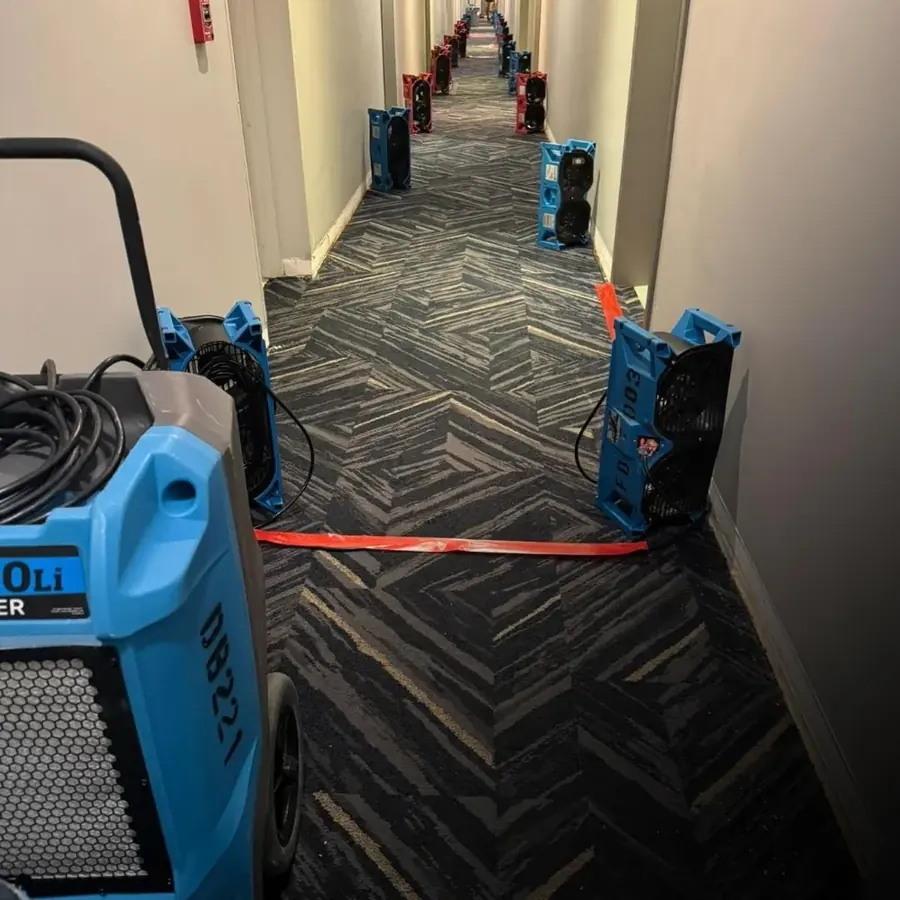
Structural drying is the science that finishes a water loss. Once the standing water is pumped out, moisture is still hiding in the framing, the slab, the subfloor, and inside the drywall, and a surface that feels dry to your hand can be soaked an inch below. Drying to a documented standard, not just a dry-looking floor, is what keeps a Dallas water loss from turning into mold and warped materials weeks later. This step is different from extraction, which removes the water you can see.
The science of drying a structure
Drying is really about moving water from where it is trapped into the air, then out of the building. That study of air, temperature, and moisture is called psychrometry, and it sounds technical but the idea is simple.
- Air movers sweep warm, dry air across wet surfaces so moisture lifts out of the framing, slab, and drywall.
- LGR dehumidifiers, short for low-grain refrigerant, pull that moisture out of the air so the room does not just re-wet itself.
- Balance matters, because too little airflow leaves wet pockets and too much without dehumidification only spreads humidity around.
Why Dallas homes hold moisture longer
North Texas humidity swings hard from day to night and season to season, and that outside moisture fights your drying. A slab-on-grade home makes it harder still.
- A saturated concrete slab releases moisture slowly and holds it far longer than drywall does.
- Humid Dallas air can re-wet materials overnight if the space is not sealed and dehumidified.
- Trapped moisture in wall cavities and under flooring feeds mold, which the U.S. Centers for Disease Control and Prevention says can take hold within one to two days.
Our structural drying process
We treat drying as a measured process with a defined finish line, not a fixed number of days.
- Moisture map the affected materials with meters so we know exactly what is wet and how wet it is.
- Set equipment by the numbers, placing air movers and LGR dehumidifiers sized to the space and the load.
- Take daily readings and adjust, because a room that reads dry on day two may reveal a wet cavity on day three.
- Dry to standard, confirming the framing, slab, and drywall have returned to a documented dry target before the equipment comes out.
Drying picks up where the water removal ends. Our water extraction crew pulls the standing water first, a slab leak loss needs extra patience for the concrete to give up its moisture, and we bring the same monitored drying to commercial water damage jobs.
Dry surface versus dry structure
A floor can feel dry while the subfloor and the bottom plate behind the baseboard are still holding water. That hidden moisture is what warps hardwood, buckles laminate, and grows mold after everyone thought the job was done. Controlling humidity is the core of prevention, and the EPA ties mold directly to unmanaged moisture. Drying to a verified standard is the only way to know the structure is truly dry.
Because we log moisture readings from the first visit to the last, Star Restoration hands your carrier clear proof the structure was dried correctly, which supports the claim and protects you from a repeat loss.
"Another company would have wiped the floor and called it done. Star Restoration mapped the moisture, ran fans and dehumidifiers for days, and showed me the readings dropping until it was actually dry. No musty smell later."
Theo M. Design District
Why Dallas calls us first
On-site in about 45 minutes
A real person answers 24/7 and a local crew rolls the moment you call, any hour, anywhere across Dallas.
IICRC certified crews
Trained technicians with truck-mounted pumps, air movers, and moisture meters, not a mop and a bucket.
We bill your insurer
We document the loss with photos and readings and work with your carrier directly, so the paperwork is not on you.
Deep Dallas knowledge
Slab leaks on clay, freeze bursts, flash floods, and old cast-iron sewers, we know how water moves here.
From the Park Cities to Oak Cliff, all of Dallas
Seated in East Dallas at 1317 Fairview Ave, we respond across the City of Dallas and the close-in metro, day or night.
Seated in East Dallas at 1317 Fairview Ave, Dallas, TX 75223, our crews cover the City of Dallas and the close-in metro, day or night, and reach most homes in about 45 minutes.
We serve the Park Cities, Lakewood, Lower Greenville, Oak Cliff, Lake Highlands, Far North Dallas, the Design District, and Uptown.
See every neighborhood and ZIP we serve ›Common questions, answered
What is structural drying?
It is the controlled process of drying the building itself, the framing, slab, subfloor, and drywall, after the standing water is removed. We use air movers and dehumidifiers with moisture readings to bring materials back to a documented dry standard.
How is drying different from water extraction?
Extraction removes the standing water you can see. Structural drying removes the moisture left behind inside materials that a pump cannot reach. Both are needed, because water left in the framing or slab causes mold and warping even after the floor looks dry.
What is an LGR dehumidifier?
LGR stands for low-grain refrigerant. It is a commercial dehumidifier that pulls far more moisture out of the air than a household unit, which is what lets a wet structure actually dry instead of re-wetting itself in Dallas humidity.
Why does drying take several days in Dallas?
Materials give up moisture slowly, and a concrete slab holds it much longer than drywall. Dallas humidity swings also fight the process, so we dry to measured targets rather than a set number of days, usually three to five with daily readings.
How do you know when my home is dry?
We take daily moisture readings and compare them to a documented dry standard for each material. When the framing, slab, and drywall reach that target, the structure is dry and we remove the equipment, not before.
Can I just use my own fans to dry it out?
Household fans move air but do not remove moisture from it, so in humid Dallas air the room re-wets itself and moisture stays trapped in the structure. Proper drying pairs air movers with commercial dehumidifiers and moisture monitoring.
Why does drying to standard matter for mold?
Mold needs moisture, and it can start within one to two days on materials that stay wet. Drying only the surface leaves damp framing and cavities that feed mold, so drying the whole structure to a verified standard is the prevention step.
How much does structural drying cost?
It depends on how much of the home got wet and how saturated the materials are. We scope the drying before starting and document the readings for your claim. Call (469) 966-7836 and we will explain what to expect.
Dallas's water damage crew is ready when you are
Water sitting means damage growing. Call Star Restoration and a local crew is on the way, on-site in about 45 minutes.
(469) 966-7836Call now, a live Dallas dispatcher answers